

MOVING2ITALY · BLOG
Moving to Italy from the USA: What Comes Before the Flight
Moving to Italy from the USA? Plan visas, work, housing, healthcare and school in the right order, with a practical checklist for your whole household.
Moving2Italy Editorial Team
Editorial team · SEPTEMBER 21, 2026 · 14 min read

Before moving to Italy from the USA, establish how each person in your household will qualify to live there and what work they can do. That answer shapes the housing search, the documents you need and when you can travel. If your plan currently rests on an Italian grandparent or a manager saying you can work abroad, you still have a few decisions to check.
Start with one page listing each family member's citizenship, proposed arrival date, work or study plans and intended immigration route. Then add the evidence each route needs. That page will tell you which commitments you can make now and which depend on an approval.
This guide takes you from that first decision through the first year. The research was checked on September 8, 2026; this guide was revised on September 9. Use the official office responsible for your application to confirm your own documents and deadlines.
Which route lets each person live and work in Italy?
The route depends on the citizenship you can document and what you will do in Italy. US-only citizens need an appropriate residence route, with permission for any work; Italian and other EU citizens start from rights they already hold, then check applicable formalities.
If you have only US citizenship
Visa-free travel is useful for a scouting trip. It generally permits short visits of up to 90 days in any 180-day period across the Schengen area; it does not give you a general right to relocate or work. For a longer move, identify the appropriate long-stay route before departure. The US Department of State's Italy travel guidance distinguishes visits from residence.
Choose the route around what you will actually do:
- Take an Italian job: ask the employer which work authorization process applies and who will submit it. A job offer alone does not complete immigration formalities. The EU Immigration Portal's employed-worker page explains the standard route; other categories have different procedures.
- Keep a qualifying remote job or freelance business: investigate the digital nomad or remote worker route. It has eligibility and evidence requirements, including professional qualifications or experience, income, accommodation and insurance. The Los Angeles consulate's checklist is a useful example, but your own consulate's instructions govern your submission.
- Retire or live on qualifying passive income: consider elective residence if you meet its requirements. This route does not authorize work, including simply continuing your US job from an Italian home. See the Italian Embassy's elective residence checklist.
- Study or join family: use the route that matches the course or family relationship. Do not assume that the main applicant's visa covers everyone else.
Our overview of Italy's visa requirements helps you compare the main paths. Once one looks plausible, move to the competent consulate's current checklist rather than collecting documents for several incompatible applications.
If you already hold Italian or another EU citizenship
You do not need a non-EU work visa to exercise rights you already hold. An Italian citizen returning to live in Italy needs the appropriate municipal registration process. Other EU citizens have residence formalities depending on the duration and basis of their stay; the EU guidance for workers explains the work-based case.
Having Italian ancestry is different from already having recognized citizenship. If recognition is pending, plan using the status you can document today. Also assess a non-EU spouse or child separately: your own passport does not replace their entry and residence paperwork. The EU guidance for non-EU family members distinguishes joining a citizen in another EU country from returning to that citizen's own country. Give the consulate your actual residence history, not just the nationality of the main applicant.
What must be settled before you book the move?
Settle the immigration route and the work arrangement together. A US employer may allow overseas work internally while still needing advice on Italian payroll, social security, employment obligations and its own tax exposure. Ask HR or the employer's adviser for a written arrangement with an effective date. A manager's chat message is a poor foundation for an international move.
For freelancers, list where you will perform the work, who your clients are and how you will invoice after moving. Those questions belong in the plan before the first Italian workday. The digital nomad visa guide covers that immigration route in more detail; qualifying for it does not settle every employment or tax question.
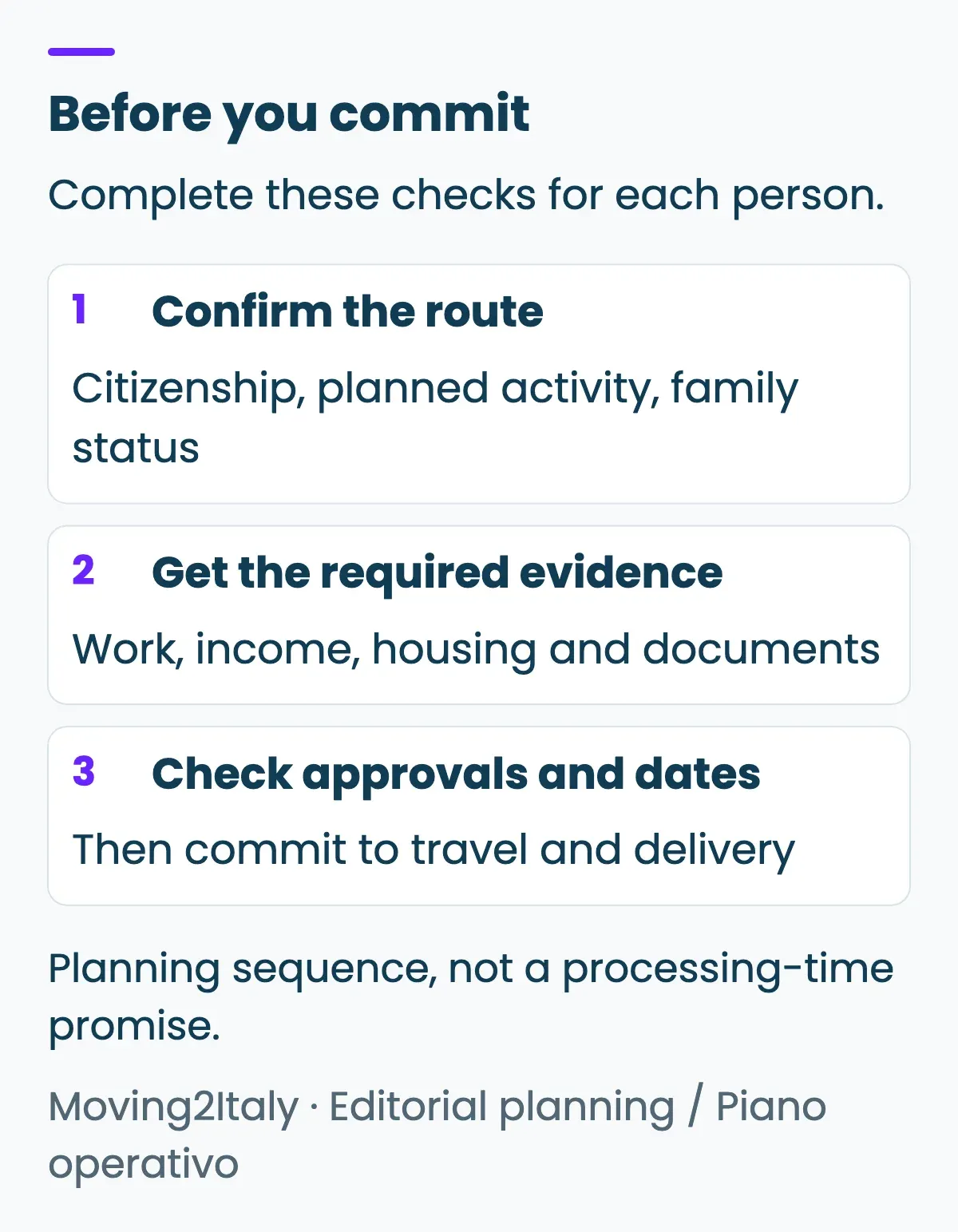
Build your moving calendar backward from the slowest unresolved dependency. That may be a consular appointment, an employer authorization, a family document or a lease acceptable for the chosen application. A planning window is not a processing-time guarantee.
Use these three checkpoints before making large nonrefundable commitments:
- Route identified: you know which authority will process each person's case and have its current checklist.
- Evidence available: income, work, family and accommodation documents can be produced in the required form.
- Timing workable: arrival, job start, school entry and the mover's delivery window fit the approvals you actually have.
How do you secure housing and the right documents?
Check the property against the paperwork and daily life you need. An attractive short stay can be useful while searching, but the booking may not meet the accommodation requirement for your visa or provide the evidence needed for municipal registration.
Before paying, ask for the proposed contract and confirm who is entitled to rent the property. Establish the term, deposit, utilities, condominium charges, heating arrangement and any agent fee. Ask how the contract will be registered and which documents the landlord can supply. Where a visa checklist requires a particular form or duration of accommodation, verify that first.
A practical shortlist should include a weekday journey to work or school, nearby healthcare, internet availability at the exact address and how you will shop without a car. Visit at the hours you will actually use the neighborhood. A quiet holiday apartment can feel very different during the school run or winter commute.
Ask the mover about access before choosing a delivery date: narrow streets, restricted traffic zones, stairs and a missing elevator can change the quote. Keep accommodation for a delayed shipment in your budget. Buying a home is a separate financial and legal decision; ownership does not itself supply permission to live in Italy.
Which documents should travel with you?
Carry the originals you may need before the shipment arrives, with secure digital copies stored separately. Keep a small folder for each person rather than one mixed stack.
Start with passports, visa or citizenship evidence, the accommodation agreement, application receipts and employment or income evidence relevant to your route. Add marriage and birth records if the receiving office needs them, school records for children, prescriptions and a concise medical summary.
Ask the receiving authority exactly which civil records require an apostille, legalization or translation. Ordering every document in every possible format wastes money; discovering that a required certified copy is still in the US wastes time. Check names and dates across passports and certificates before submitting them.
You will also need a codice fiscale, the Italian tax identification code, for many transactions. Obtain an officially assigned code and its evidence through the channel applicable to your status. The Foreign Ministry's tax-code guidance explains the different channels. An online code generator is not a substitute for official assignment, and not every consulate handles every request in the same way.
Before closing US services, test access to banks, retirement accounts and government accounts from abroad. Update contact details honestly, check each provider's rules for overseas residents and make sure two-factor authentication will survive a change of phone number.
How much cash should you keep available during the transition?
Calculate the overlap between two households. A monthly cost-of-living average will not show the deposit, temporary accommodation, storage or weeks when your old rent and new rent overlap. List when each payment falls due and how much cash remains available afterward.
Use your own written quotes in five budget lines:
- Applications: official fees, appointments, document copies, translations and any required legalization.
- Housing setup: deposit, initial rent, agreed fees, utilities and essential furnishings.
- The physical move: flights, luggage, shipping, insurance, storage and final delivery.
- The waiting period: temporary housing, health coverage and living expenses before income or local services are in place.
- An accessible reserve: money you can use if an appointment or delivery moves.
For illustration only, suppose your planning figures are €3,000 for housing entry costs, €2,000 for travel and documents, €4,000 for shipping and €2,500 per month during a two-month transition. That is €14,000 before a contingency. These are invented inputs to demonstrate the calculation, not Italian price averages or a recommended minimum.
Keep estimates and confirmed quotes in separate columns. When comparing movers, check whether destination charges and customs handling are included. When comparing transfers, compare the euros that will arrive after fees and the exchange rate, not just the advertised transfer fee. Mark when each payment is due and whether it is refundable: money tied up in a deposit cannot also cover a delayed paycheck.
If you are comparing an Italian salary offer, the Italian net salary calculator can help you explore an estimate. It is not a cross-border assessment or a test of eligibility for tax relief.
What should you ship, sell or arrange separately?
Give the shipment, the pet's travel and the car their own deadlines. A mover can coordinate the furniture while your veterinarian prepares the animal's documents; neither settles whether you can drive your US car in Italy. Assign an owner to each separate task.
Household goods
Prepare an inventory and ask the mover or customs representative what evidence is needed for transfer-of-residence relief. The Italian Customs Agency's FAQ sets conditions including, ordinarily, residence outside the EU for 12 consecutive months and prior possession and use of the goods for six months. Exceptions and restrictions apply; relief is not automatic just because a shipment contains used furniture.
Keep customs documents accessible. Agree who handles clearance, what happens if residence evidence is pending and when storage charges begin. Decide whether large appliances and furniture are worth shipping after checking the Italian home's dimensions and electrical compatibility.
Pets
Start with a USDA-accredited veterinarian and the APHIS page for travel from the US to Italy. The sequence of identification, vaccination, certification and endorsement matters, as do the animal's itinerary and whether it travels with you.
For departures around October 2026, have the veterinarian check the certificate transition specifically. APHIS's September 2 update gives October 1 for new non-commercial certificates and October 17 for commercial certificates, with transition provisions. Avoid using a certificate saved from an older blog post. Airline acceptance and crate rules need a separate check.
Driving and a US vehicle
Treat the right to drive and the right to import and register a car as different questions. Article 135 of Italy's Highway Code allows holders of a valid non-EU/EEA license to drive, within the applicable categories, while they have not been resident in Italy for more than one year. The license must accompany a valid international driving permit or an official Italian translation. Ask the Motorizzazione to confirm your license's conversion or examination route; do not assume exchange is available.
Obtain a separate vehicle assessment covering customs, technical compliance, registration and insurance before shipping a US car. A customs exemption does not answer the registration question.
How do healthcare and school continue through the move?
Arrange healthcare for the period between arrival and confirmed access to the system appropriate to your status. Italy's Servizio Sanitario Nazionale (SSN) is the public health service. Entitlement, mandatory or voluntary enrollment, and the evidence required depend on your circumstances; public healthcare is not automatically free for every new arrival.
The Italian Revenue Agency's health-card guidance distinguishes enrollment from card issuance. Confirm your route with the local health authority, usually called an ASL or a regional equivalent; an administrative guide is not a current fee quote.
Before departure, ask your insurer when US coverage ends and what the replacement policy covers in Italy. Discuss ongoing treatment with your clinician, including medicine names, available supply and how to arrange follow-up. Ask the Italian health office what it needs for enrollment and choosing a family doctor or pediatrician; do not make a plastic health card's delivery date your care plan.
For children, contact schools while comparing neighborhoods. Ask about placement, language support, records, enrollment during the year and the actual school day. Meals, transport and after-school care may require separate arrangements. Italian rules protect foreign minors' access to school, including applications during the school year; see the government's guidance on foreign minors' education. This explains the access principle, not the current year's enrollment calendar. The school should advise on the individual placement, rather than a parent guessing the equivalent grade. Ask which records can follow later and which are needed now; do not wait for every adult document to be finalized before contacting the school.
Keep a separate care plan for each family member. Record the last covered day under the old arrangement, the proposed replacement and the office confirming its start.
What must happen after arrival, and what can run in parallel?
Complete the immigration follow-up that applies to your route. A visa and a residence permit are different documents. For national-visa arrivals required to apply for a permesso di soggiorno, the Italian residence permit, the Miami consulate's instructions specify application within eight working days of arrival.
Confirm the submission channel for your permit type before flying and carry its documents with you.
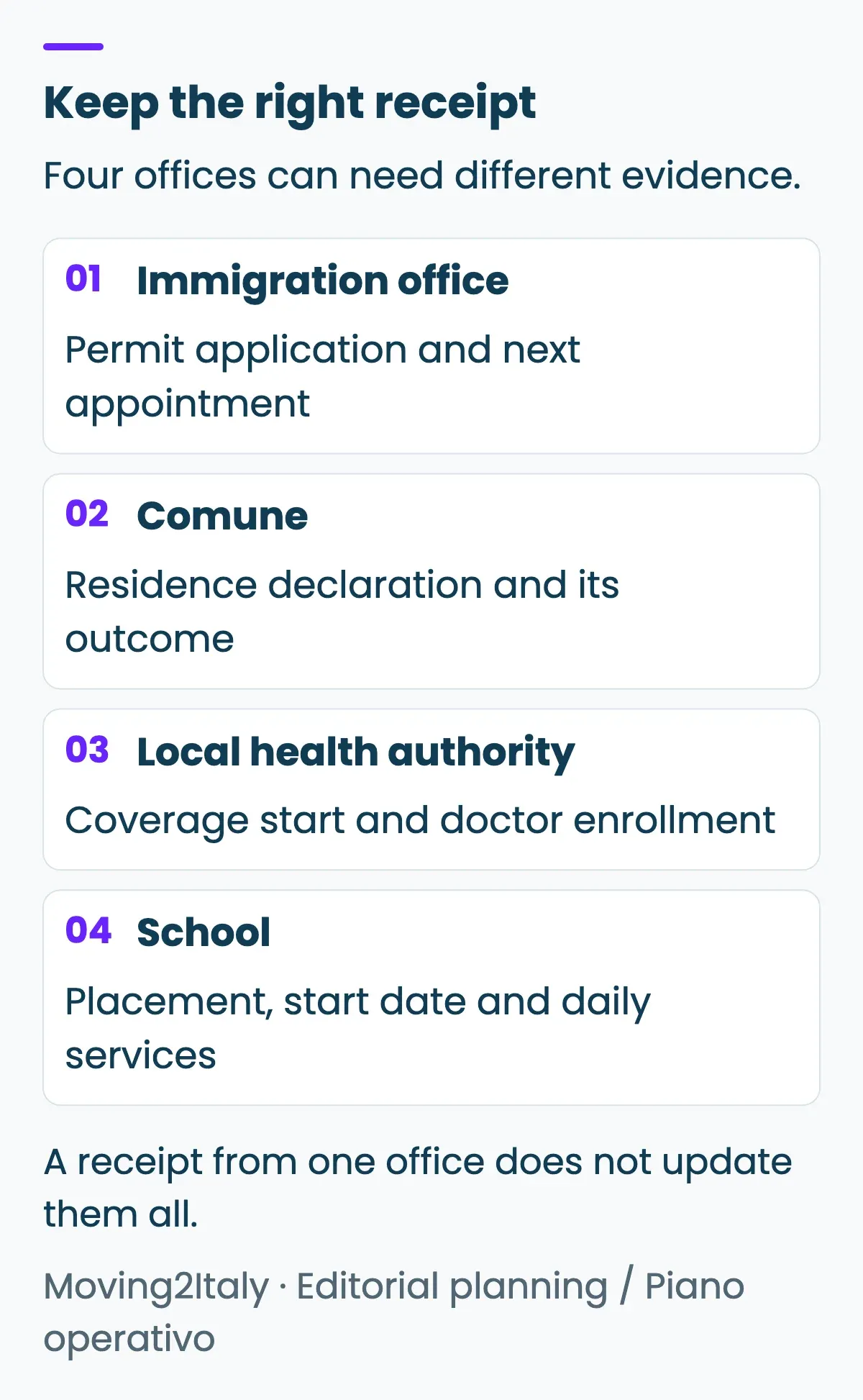
Alongside that process, handle municipal residence registration when you have actually established your habitual home and meet the requirements for your status. The municipality, or Comune, deals with this process. It is separate from the immigration office, even when they need overlapping documents. Ask the Comune which housing and status evidence it accepts, and whether your first registration can use the ANPR residence-change service. Online access is not universal for every first arrival.
Do not make the final permit card a universal starting signal. The government's pending-permit guidance explains that receipts can support some steps, depending on the application and status. Ask each receiving office whether your particular receipt is sufficient. This does not turn a non-working residence route into permission to work.
Keep a dated list of submissions and receipts. Record the office, reference number, missing item and next action. A document received by one office is not proof that every other office has updated its records.
Which US and Italian records should you keep for the first tax year?
Keep records from the start of the move. Your visa, address registration and tax residence answer different questions. A tax-residence review considers the Italian Revenue Agency's residence guidance, circular 20/E of November 4, 2024 and, where relevant, the treaty; counting flight days alone does not resolve every case.
Record travel dates, where work was performed, home availability, family moves, employment changes and income received. Retain bank and investment statements, retirement-account records, property documents and evidence of foreign tax paid. Give the same timeline to the professionals reviewing the Italian and US sides.
Moving abroad generally does not end US citizens' federal tax responsibilities. The IRS explains that worldwide-income rules continue to apply, with filing requirements depending on the facts. Credits or exclusions may help, but are not automatic exemptions from filing. Foreign-account reporting and any continuing state connections deserve a separate check.
Our guide to taxes in Italy for foreigners provides background for that conversation. Build an affordable plan before assuming you qualify for any preferential regime.
What does the household checklist look like?
Use this as a working record, not a fixed queue. Some rows run together; others wait for a specific document. Name the responsible person and add the next unresolved question before marking a milestone complete. The linked authorities determine the requirements in your case.
Select each person's route
Prerequisite: Citizenship, activity, family relationship
Owner: Each adult
Evidence to keep: current checklist and appointment record
Office / official check: Competent Italian consulate
Unresolved question: Correct consular district?
Set the work start date
Prerequisite: Work authorization and employer arrangement
Owner: Applicant and employer
Evidence to keep: written terms and approvals
Office / official check: EU employment route
Unresolved question: Start date approved?
Assemble accommodation evidence
Prerequisite: The chosen route and actual property
Owner: Applicant and landlord
Evidence to keep: contract and registration evidence
Office / official check: Consulate checklist; destination Comune
Unresolved question: Evidence accepted?
Obtain or verify the tax code
Prerequisite: Correct official channel for your status
Owner: Applicant
Evidence to keep: official assignment certificate
Office / official check: MAECI
Unresolved question: Code already assigned?
Release the shipment
Prerequisite: Inventory, customs eligibility, delivery access
Owner: Household and mover
Evidence to keep: quote and clearance documents
Office / official check: ADM
Unresolved question: Pending documents accepted?
Submit permit application, if required
Prerequisite: Arrival and route-specific documents
Owner: Applicant
Evidence to keep: dated submission receipt
Office / official check: Consular arrival instructions
Unresolved question: Which submission channel?
Register municipal residence
Prerequisite: Actual home and status-specific evidence
Owner: Each household
Evidence to keep: submission and outcome
Office / official check: Destination Comune's anagrafe office
Unresolved question: Receipt sufficient?
Confirm health access and doctor
Prerequisite: Your entitlement and local registration requirements
Owner: Each adult and parent
Evidence to keep: coverage dates and enrollment evidence
Office / official check: Health-card guidance and local ASL
Unresolved question: Coverage start confirmed?
Complete school arrangements
Prerequisite: School's placement review and requested records
Owner: Parent and school
Evidence to keep: acceptance and start arrangements
Office / official check: Government education guidance
Unresolved question: Records to follow?
Review first-year obligations
Prerequisite: Actual travel, work, income and assets
Owner: Household and advisers
Evidence to keep: dated evidence file
Office / official check: IRS overseas guidance and Italian Revenue Agency
Unresolved question: Both countries covered?
What is the next practical step?
For moving to Italy from the USA, start with the household route sheet. Identify the missing evidence that prevents your next commitment.
Bring questions about immigration eligibility or your work arrangement's tax consequences to an immigration or tax consultation. For a lease document, school place or shipping quote, contact the landlord, school or mover directly. Put their answer and the next deadline on your sheet.